
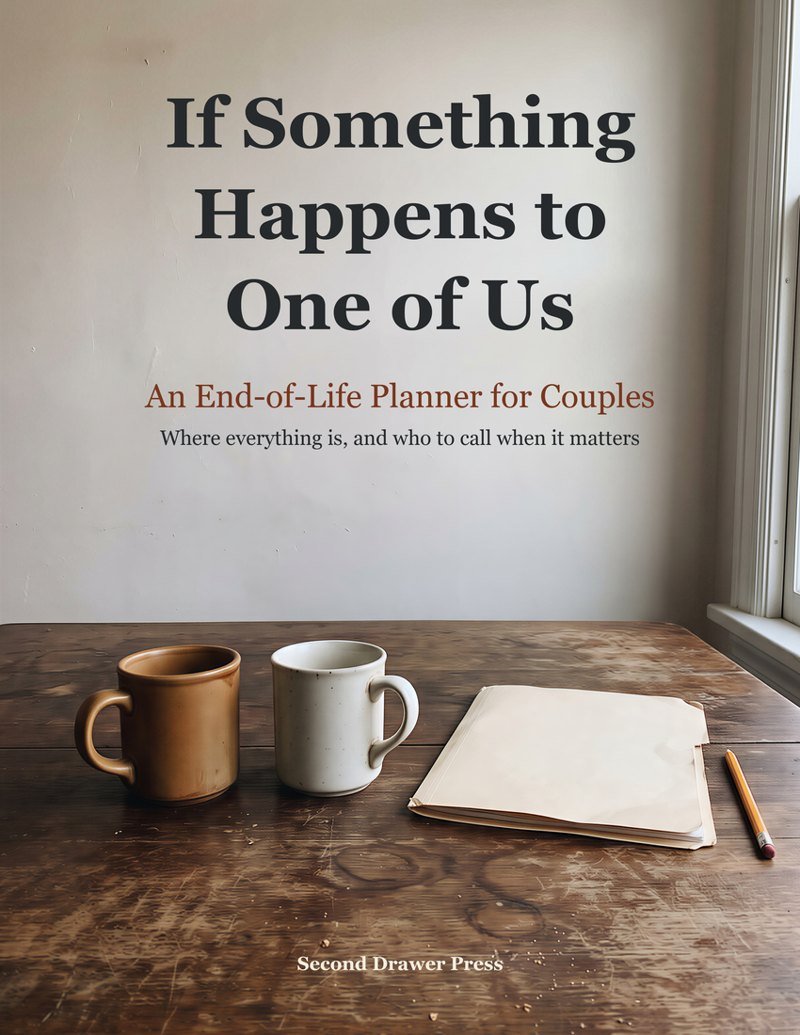
Coach C. here. Most of us know we should write this stuff down. If Something Happens to One of Us: An End-of-Life Planner for Couples, from Second Drawer Press, is a 100-page book that gives you the blanks to do it. It costs $14.99 in paperback.
Quick facts
- Format: fill-in planner, paperback only, 8.5 x 11, 100 pages, black and white
- Price: $14.99 when this review was written
- Publisher: Second Drawer Press, November 2026
- Best for: married couples where one of you handles most of the money or the house
- Not: a will, a legal form or a Christian devotional
What’s the Premise?
In most marriages each of you knows things the other doesn’t. One of you knows which bank holds the savings and when the car insurance renews. The other knows the kids’ doctors and which neighbor has the spare key. Nobody wrote any of it down, because nothing has gone wrong yet.
Then one of you is gone, or in a hospital bed, and the other is working through bills and phone calls during the worst week of their life. The book’s own line on it: “That works beautifully right up until it doesn’t.”
There are no chapters to read and no argument to follow. It’s a final wishes organizer and a household record in one. You fill it in together, and what it’s worth depends on what you write.
Who’s This Book For?
- Married couples where one person handles most of the money or the house
- Men who have meant to get to this for twenty years
- Couples with kids at home, a blended family or aging parents, since each gets its own pages
- Adult children looking for something practical to give their parents
What Stands Out in This End-of-Life Planner
The first page for the bad day. “If you’re reading this because something has happened” is a one-page checklist for the first few days. The last item reads, “Eat something and drink some water. Accept the casserole.”
It stays out of the legal questions. The “Where Things Are” section covers wills, deeds, titles, keys, safe deposit boxes and storage units. You record where each one is kept, and the book never tells you what any of them should say.
No passwords. The online accounts pages have you note where your passwords are kept and who can get to them, which is the right call for a book that sits in a drawer.
The bills pages. There are three pages of monthly bills, plus yearly bills and subscriptions. The book’s note calls them possibly “the most useful page in the book,” and if one of you handles all of it, I think that’s right.
The hard pages. The service page asks “Who should absolutely not speak.” Further back, each of you answers what you’d want for the other afterward: staying in the house, keeping on working, and “If you meet someone new.” Then come letters to each other and to the people you love. Most couples never have that conversation, and these pages are the best reason to buy it.
Past that, there are sections for who to call, insurance, how the house works, medications, the kids and the pets.
Where It Might Miss for Some
- It isn’t a Christian book. It has no Scripture and no devotional content. Faith shows up as a line for your “Pastor, priest, rabbi or other” and one blank that reads “My faith, and what it means here.” The book leaves that blank to you.
- It doesn’t do any legal work. It says so on the copyright page: filling it in doesn’t change who inherits anything or who can act for you. You still need a will and a directive, and for those you need an attorney.
- It’s built for two. If you’re single, buy something else.
- You can’t add pages. It’s a bound paperback at 8.5 x 11 with black and white pages, and beyond four pages of notes, what’s printed is all the room you get. A binder would let you grow it.
- You could do this for free. A legal pad and a few Sundays gets you most of the way. What you pay for is the list of questions, so you don’t have to think them up yourselves.
Practical Use: How to Apply It
- Don’t try to finish it in one sitting. The book says to start with the section that worries you most, and that an hour on a Sunday gets you a long way.
- Use a pencil for anything that changes, like phone numbers and bills.
- Leave blanks. A half-filled book still helps.
- Keep it somewhere safe, because it will hold a lot of private information, and tell one or two people you trust where it is.
- Update it once a year. Pick a date you won’t forget.
End-of-Life Planner for Couples: Common Questions
What should be in an end-of-life planner for couples?
At minimum: who to call first, where the important papers and keys are, bank accounts and bills, insurance, online accounts, medications and doctors, who looks after the kids and pets, and what each of you wants for a service. This one covers all of those, with room for each spouse’s answers where they differ.
What does my spouse need to know if something happens to me?
Start with what only you know. That usually means which bills are on autopay, who to call about the life insurance, where the will is and how to get into your phone. This book has a place for each of those. For the phone, you note where the unlock code is kept, not the code.
Is this planner a legal document?
No. It records where your documents are and what you’d like. It doesn’t replace a will, a power of attorney or a health care directive, and filling it in doesn’t change who inherits anything.
Should we write our passwords in it?
No, and the book tells you not to. You write down where the passwords are kept and who can get to them. For accounts, it asks for the last four digits only.
Does it work as a gift for aging parents?
It can, if they’re a couple and you know they’d use it. A blank planner on a shelf helps nobody, so it’s worth offering to sit down with them for the section that worries them most.
Affiliate Book Link
If Something Happens to One of Us by Second Drawer Press
Coach’s Verdict
Buy it if: you and your wife have been putting this off and a set of blanks would finally get you to sit down.
Skip it if: you want Scripture, legal forms or a book to read, or you’d do the same job on a legal pad.